





Why Connecting Survivors of Sexual Assault to Resources Is Harder Than It Sounds
July 6, 2026
Made with in Raleigh, NC, USA
© Our Wave 2026. All rights reserved.
Show resources for
 New Zealand
July 6, 2026
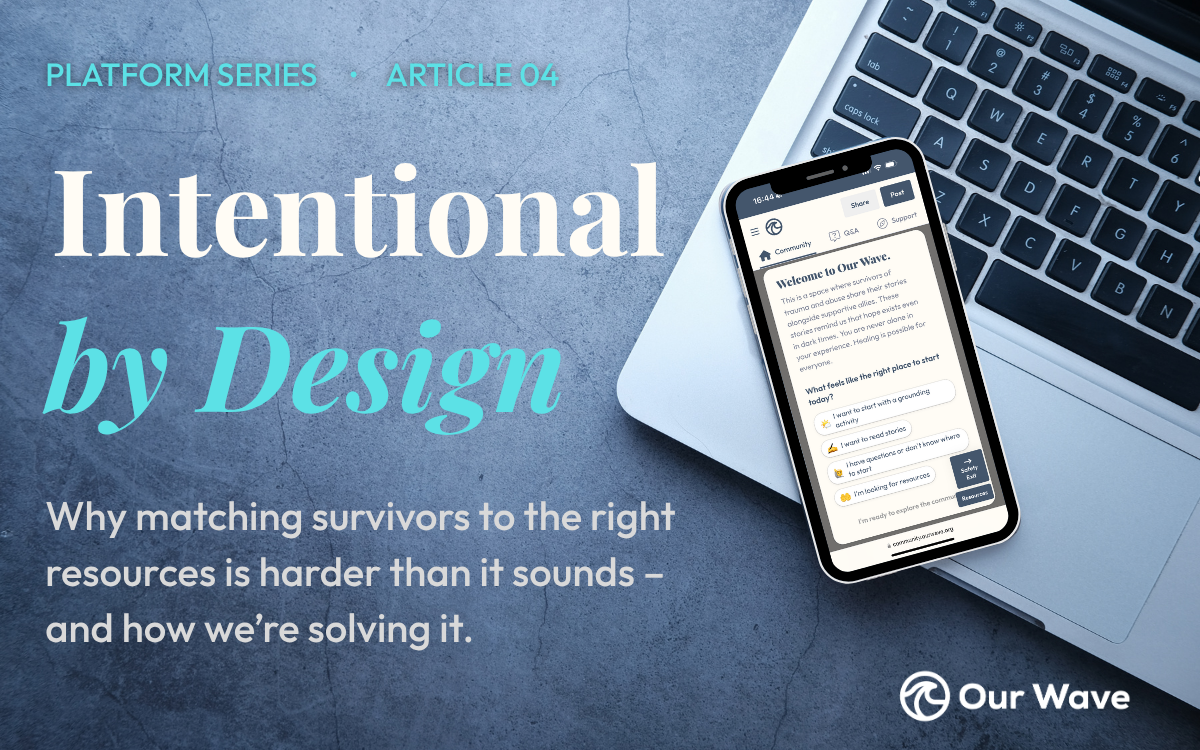
This is the fourth article in our Intentional by Design series. Read the first article on the technology behind our community platform, the second article on the philosophy guiding every tech decision we make, and the third article on whether AI tools are safe for survivors.
The gender-based violence (GBV) and sexual assault field has built a meaningful network of support infrastructure over the past several decades. Hotlines, crisis centers, legal advocates, support groups, and counseling services exist because advocates fought hard to create them.
Online platforms have become part of this infrastructure too, offering survivors a way to share their story, get support, or connect to resources. But there’s a problem most of these platforms still haven’t solved.
Resource matching refers to connecting each survivor to support that fits their situation at the right time. That’s harder than it sounds, and most platforms still aren’t doing it.
Our Wave has been connecting survivors to resources since our founding in 2019. We’ve made more than 268,000 resource referrals to a community of more than 558,000 people across 79 countries. This article explores our resource referral system, how we built it, and where it’s going next.
When we launched in 2019, our resource referrals worked the way most platforms still work today. They were a curated list of well-known organizations, shown to every person, regardless of who they were or what they’d been through.Think of simple, organized bulleted lists, like:
RAINN: Operates the National Sexual Assault Hotline and partners with local sexual assault service providers to improve public policy, train professionals, and support survivors.
988 Suicide and Crisis Hotline: Connects people in emotional distress or crisis with trained counselors, available 24/7 by call, text, or chat.
NSVRC: Supports research, prevention, and advocacy work around sexual violence and provides resources and training to organizations.
These are established, vetted, and reliable resources. They matter for the people they reach. In 2024, according to RAINN’s impact report, the organization helped more than 412,000 survivors through its victim service programs.
But a static list like this has limits, and these limits become more visible the bigger and more global a community gets. A survivor in Kenya, for example, sees the same hotlines as a survivor in Iowa. A queer survivor, a male survivor, a person navigating the aftermath of childhood abuse or COCSA, or someone dealing with intimate image abuse encounters the same list as everyone else.
And there’s an implicit message behind all this. Even if it’s unintentional, resources formatted in this way risk implying to survivors that we don’t know who they really are.
When a survivor takes the step of reaching out for help, what they find on the other end of that search shapes what they do next. A resource that doesn’t reflect their situation, or that offers nothing in their country, fails to help them. It also sends the message that their experience doesn’t fit the standard categories.
We see this across the 1,852 stories currently published on our platform. Our community includes survivors of emotional abuse and financial abuse alongside physical harm. It includes people who were harmed by family members, authority figures, and by strangers. It spans 79 countries and reflects a wide range of identities, orientations, and experiences.
They don’t all need the same resources, but for a long time, we were giving them all the same ones.
Our work to connect survivors to the right support has moved in phases throughout the years. Our technology has consistently adapted to better understand what a survivor actually needs, from location tracking, semantic matching, and human review.
In 2024, we took the first step beyond a static list of resources. We began tagging every resource in our library with the countries and regions it serves, and filtering what a survivor sees based on where they submitted from. A survivor in Brazil sees Brazilian resources and a survivor in the U.K. sees U.K. resources.
This was an important improvement, but it also revealed the next problem. Our platform has expanded its resource infrastructure across 28 countries, but many countries still have thin or no coverage in our library. A location filter doesn’t help a survivor in a country where vetted resources don’t exist yet.
And even where coverage is strong, location only tells us where someone is. It tells us nothing about what they need. Two survivors in the same city can be in entirely different situations. One could be in immediate crisis, and another could be processing something from years ago. They live in the same place, but they don’t need the same resources.
This year, we moved to a more substantive approach to resource matching. Instead of matching resources based only on where a survivor is, our system now reads what they wrote and finds resources based on meaning, not just location. This means that someone’s story, message, or question will help us source the right resources for them.
What is retrieval-augmented generation (RAG)? It's an AI pipeline that reads the meaning of a survivor's words and matches them against a library of resource documents, finding the most relevant result based on context, not just keywords.
Basically, we built detailed context documents for each resource in our library. The system then compares the meaning of a survivor’s words on our platform against those resource documents.
A story about going to the police reads differently than one about an unsupportive family. A message about childhood trauma looks different than a question about intimate image abuse. The system starts to hear those differences and surfaces resources that correspond.
Plus, location filtering still applies on top, so a survivor in a specific country only sees resources that serve them. For the first time, we’re asking not just “where is this person?” but “what are they telling us?”
As we’ve explained throughout this series, Our Wave does not operate a single sensitive AI use case without a human in the loop reviewing the results. This is a principle we’ve outlined clearly in our AI policy.
Resource matching is no exception. Every resource in our library is vetted by a human before it ever enters the matching pool. Then, our matching output is monitored on an ongoing basis to catch any gaps or low-quality results.
One recent study on digital platforms for domestic violence survivors found that while participants value AI tools for accessible and efficient information filtering, they raised consistent concerns about chatbot limitations in empathy, personalization, and accuracy.
A system that reads unstructured survivor content can surface strong matches. It can also miss context, weigh the wrong signals, or apply a training pattern that doesn’t fit a particular survivor’s situation. Human review is how we catch that before it reaches the person who came looking for help.
Reading the meaning of what a survivor writes is a meaningful step forward. But there are things that our current system still can’t resolve on its own. Here’s where the gaps are and what we’re doing about it:
Safety prioritization: A survivor in immediate danger needs a crisis line before anything else, regardless of topical relevance. A retrieval system that ranks resources by semantic match can surface a relevant result without surfacing the right one. The next phase of our work addresses this. If a submission mentions immediate danger, crisis resources move to the front.
Identity-fit: Knowing what a survivor wrote doesn’t automatically tell our system whether a resource actually serves their identity. We’re working toward explicit identity-fit evaluation as a separate part in the matching pipeline. For example, a queer survivor is matched with resources that affirm their identity, not just ones that address the type of harm.
Coverage gaps: Semantic matching helps where strong coverage exists. We’re actively adding vetted resources to our library where coverage is thin, expanding our partnerships with local and regional organizations.
Resource matching is a long-term investment. It’s not a single feature that we build and update occasionally. Instead, it means understanding what each survivor is looking for and making sure our resource library is specific enough to meet them there. It requires clinical and cultural research, survivor and advocate input, and ongoing evaluation.
Our current pipeline represents a real shift from where we started. We’ve gone from showing everyone the same list, to filtering by location, to reading what survivors actually write. Each step has made the system more responsive. Resource matching that meets survivors where they are, reflects who they are, and puts their safety first is worth every careful, incremental step it takes.
If your organization is working on aligned digital infrastructure for survivors, we'd love to connect. To explore the resources our community has access to, visit our platform. For a full look at how we govern AI across all of our features, read our AI Policy.
Most platforms offer the same curated list of resources to every survivor of sexual harm, regardless of who they are or what they’ve been through. Resource matching is the work of connecting each survivor to support that actually fits their situation, identity, and location.
We’ve built on our approach incrementally since 2019. We started with a static list, added location filtering and introduced semantic matching. Human review is applied at every stage, and a multi-component approach that includes explicit safety prioritization is the next phase of development.
If we don't have vetted resources for a survivor's country, they'll see what's available. At Our Wave, we acknowledge coverage gaps honestly. We're actively building out coverage in more countries, with cultural and clinical review. Smart matching only works if the resources are there in the first place.
This is the fourth article in the Intentional by Design series, exploring the technology, philosophy, and research being built at Our Wave.
Our Wave depends on your generous contributions for our continued success. Give today and support us as we work to support survivors of sexual harm and domestic violence.
Read stories Give todayUpdates, events, and ways to help out. Directly to your inbox.
New ZealandOur Wave is a 501(c)(3) nonprofit organization and an anonymous service. For additional resources, visit the Our Wave Resources Hub. If this is an emergency, please contact your local emergency service.