Intentional by Design: How Our Wave Approaches Trauma-Informed Technology for Survivors
April 28, 2026
Join us in directly supporting survivors of sexual harm, domestic violence, and child abuse by giving a gift today. We depend on your generous contributions for our continued success. Every little bit helps ❤️
We depend on your generous contributions for our continued success. Every little bit helps ❤️


Language Barriers in Survivor Support: When No One Can Read Your Story
Volunteer
Give today
Language Barriers in Survivor Support: When No One Can Read Your Story
Volunteer
Give today
Language Barriers in Survivor Support: When No One Can Read Your Story
Press & Media
Give today
Made with in Raleigh, NC, USA
© Our Wave 2026. All rights reserved.
April 28, 2026
Show resources for
 Paraguay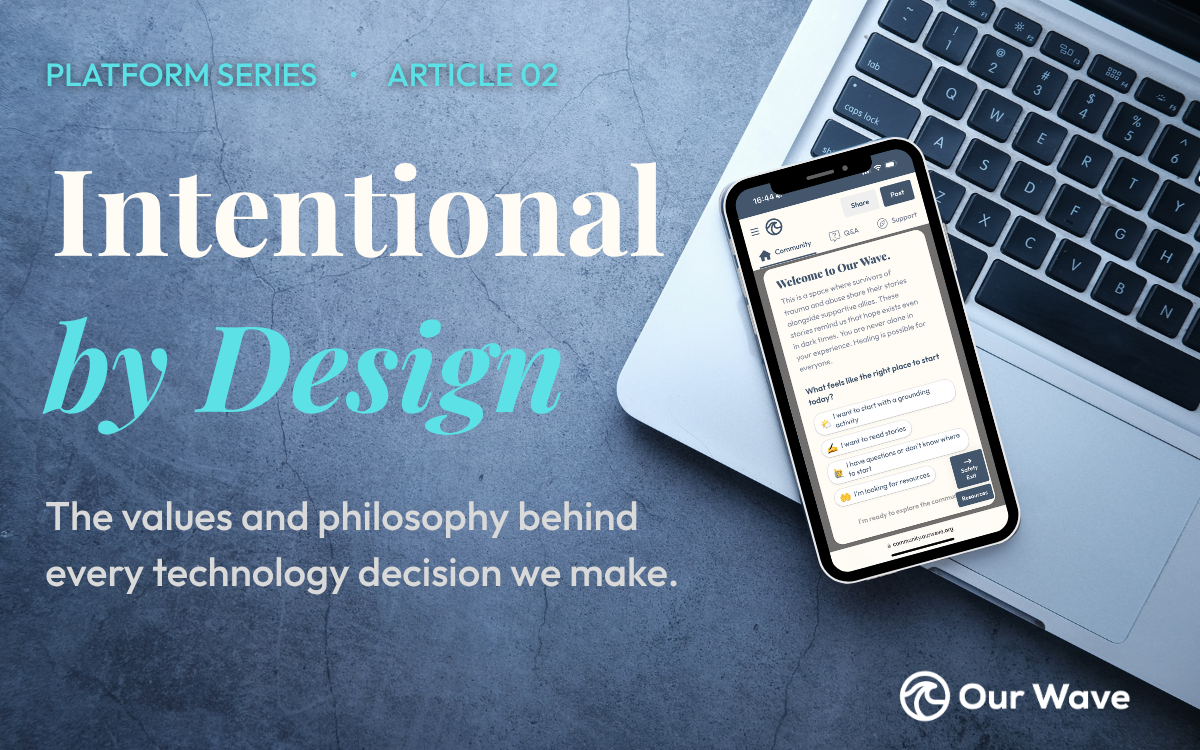
This is the second article in our Intentional by Design series on the technology behind Our Wave. Read the first article here.
Conversations around AI technology in the gender-based violence (GBV) and sexual assault field are getting louder. New tools are launching constantly with the promise of reaching more survivors, answering questions faster, and building support that scales. But this promise also brings new questions about what these tools mean for the survivors who use them.
As a trauma-informed survivor community platform that has supported more than 528,000 users across 78 countries, we've been thinking carefully about how technology intersects with survivor healing since our founding. That thinking has only sharpened as AI has moved from a background consideration to a front-and-center one for the entire field.
The first article in this series introduced our platform as it stands today: our privacy architecture, our community features, and the survivor-centered research infrastructure the platform is built on. This article is about what drives all of those decisions. Not just about what we've built, but how we think about building it.
One of the things we're consistent about when talking with partners and funders is acknowledging their concerns around AI tools. Concerns are valid; the tools are evolving quickly. There's a lot still being figured out in this space.
The survivor community we serve has often already experienced harm from systems and institutions that failed them. We always keep this history close in our thinking. It shapes and informs every decision we make.
"There are varying levels of risk depending on the use case. If you implement an AI therapist, for example, that's extremely risky — versus using AI for data classification that a human reviews. That's much less risky because a human is in the loop approving the final submittable version. We're always evaluating the risk based on the specific use case." – Kyle Linton, Co-Founder and Executive Director
That risk evaluation rests on two things that we don’t compromise on. First, human oversight. Our Wave does not operate a single sensitive AI use case that doesn't have a human in the loop reviewing the results.
Second, data responsibility. We use commercial licensing for AI tools so that survivor data stays private and is not used for model training. We have our lawyers review the terms of service for any tool before we bring it in, including data ownership, retention policies, and licensing terms. Identifying information is always redacted before any content touches an AI system.
We've written about the real consequences of technology getting this wrong. The Tea app data breach is one example we've covered of how quickly trust can be broken when platforms don't take data protection seriously. And we've watched the rise of AI-generated sexual abuse material accelerate at a pace that demands organizations like ours to think clearly about what we build and why.
For a full look at how we govern AI at Our Wave, you can read our new AI Policy.
A common question we get from technology and advocacy partners is how we decide when to build something ourselves versus when to adapt what already exists.
"We focus our custom work specifically on the things that survivors directly touch and use. The front-line user experience for survivors — we're hand-rolling that, customizing it so we can tweak it to survivors' needs. For the back-end infrastructure, we use best-in-class third-party technologies. That lets us stay nimble and agile." – Brendan Michaelsen, Co-Founder and Chief Technology Officer
In practice, this means the moments survivors actually experience on our platform (sharing a story, grounding exercises, reading a Q&A response from a trauma-informed expert) get the most careful, custom attention. The infrastructure supporting those moments draws from well-documented, reputable tools where we've evaluated how data is handled.
Trauma-informed technology means designing every feature around survivor consent, agency, and safety. It’s not just adding a content warning or an escape button. For us, it's a specific set of decisions that show up at every stage of design and development.
"It's about ensuring that survivors still feel in control of their experience. We're not completely hand-holding them or attempting to tell them what they need, without them feeling like they have a voice in their own journey. We really resist the tendency in the tech world to automate everything and make users as hands-off as possible. Our users need to have agency. Survivors need to feel like they have a voice." – Brendan
Additionally, any content that reaches survivors is always read and validated by a team member with expertise before it goes out. This is not only for the accuracy of the content, but for the language and the voice in which we’re delivering it.
“While factual information matters, how it’s delivered matters just as much.” – Laura Sinko, Director of Research and Survivor Support
Nonprofits, crisis lines, and advocacy organizations have always put direct service first. That's exactly as it should be. But it does mean that building digital infrastructure often comes second, and the resources to invest in it haven't always been there. More and more survivors are turning to the internet for support and what they find there doesn't always meet them well.
"We just don't really have a rich digital survivor support infrastructure right now as a field. The evaluation of online spaces and tools that are being created hasn't been as rigorous as we need to really understand what works and what doesn't. There's an opportunity to not just build something, but also see if it's actually working." – Laura
For us, this means doing digital field work before building anything new. We study what already exists and how survivors navigate the digital landscape. This includes reviewing the tools survivors turn to, what works, what falls short, and where real gaps remain.
"Survivors are increasingly using plain text, needs-based searching — they describe how they feel and want to find something that actually matches. But this requires our industry to move away from static lists and libraries of resources that all fit within standard boxes. The biggest gap is smart curation, based on the persona of the survivor and what they're actually looking for." – Brendan
Over the coming months, this blog series will take a closer look at each of these initiatives below. Here’s a preview of what we’re working on.
Survivors are already using general AI systems to seek information, process their experiences, and find support. But there are currently no rigorous standards, like the NIST AI Risk Management Framework, specifically designed to evaluate how safe these systems are for survivor populations.
This project is being built in collaboration with specialists in survivor advocacy and AI benchmarking, including our own research team. Specifically, the project evaluates AI systems across three areas:
How they handle crisis response
How consistently and appropriately they respond across different survivor identities and experiences
Whether they maintain safety guardrails for users who haven't labeled or named what they've been through
The goals are to improve our own systems, provide actionable findings to advocates across the broader field, and in some cases, apply pressure on AI providers to raise safety standards.
Harbor is Our Wave's flagship healing program. It's the most significant expansion of our platform to date, and it's built around one central question: what does a clear, structured pathway to healing actually look like for survivors?
"From the very first draft of our mission back in 2019, we had this idea that wherever a survivor came in, at the end of their experience with Our Wave, we wanted them to feel more grounded — like the seas were calmer in their lives. The community was always meant to support something much bigger." – Brendan
Harbor is built on evidence-informed psychotherapy practices and designed to give survivors a flexible healing journey they can engage with on their own terms, at their own pace. This type of self-directed, accessible support can be an important complement to traditional care, particularly for survivors navigating barriers to in-person services.
One of the tools supporting Harbor's development is a research synthesis tool that pulls clinical and academic literature together to help our team build the curriculum. It helps ensure the content is grounded in current knowledge, written in plain language, and accessible to survivors across different backgrounds.
Harbor is also a research opportunity. Our community reaches survivors who are often underrepresented in academic studies, and their engagement with Harbor opens a path to broadening who gets included in the research that shapes how the field understands healing.
Survivors are out there asking questions right now. They might be in online communities, social platforms, and general spaces that weren't designed with them in mind. A lot of those questions go unanswered. Others get responses that lack the care or accuracy they deserve.
We've spent years building a content library grounded in trauma-informed expertise, including over 900 expert-reviewed Q&A responses on our community platform. The next step is exploring how that knowledge can reach survivors in the spaces where they already are, rather than waiting for them to find us.
More details on this work will come as it develops.
These projects exist because we see what survivors are searching for online and what isn’t there to meet them. We are a small but mighty team. We don’t have unlimited resources, but because of our research, we have a clear sense of what the digital GBV and sexual assault space needs. And we carry a commitment to keep building carefully, responsibly, and with survivors at the center of every decision.
"When we think about scaling responsibly for a platform serving survivors, it means using technology as an accelerant — not as a replacement for the human judgment and expertise that this community deserves,” – Kyle
The tools will keep evolving. Our values won’t.
The next article in this series goes deeper into our AI benchmarking project. In the meantime, explore our community platform or reach out about partnership opportunities if your organization is working on aligned digital infrastructure for survivors.
This is the second article in the Intentional by Design series, exploring the technology, philosophy, and tools being built at Our Wave. Read the first article here.
Our Wave depends on your generous contributions for our continued success. Give today and support us as we work to support survivors of sexual harm, domestic violence, and child abuse.
Read stories Give todayUpdates, events, and ways to help out. Directly to your inbox.
ParaguayOur Wave is a 501(c)(3) nonprofit organization and an anonymous service. For additional resources, visit the Our Wave Resources Hub. If this is an emergency, please contact your local emergency service.








Join the survivors, advocates, and allies making change happen. Updates, events, and ways to help — right to your inbox.