
Research Paper: Pathways of Trauma Recovery Among Survivors of Gender-Based Violence
noviembre 10, 2026 • Global Qualitative Nursing Research
noviembre 10, 2026 • Global Qualitative Nursing Research
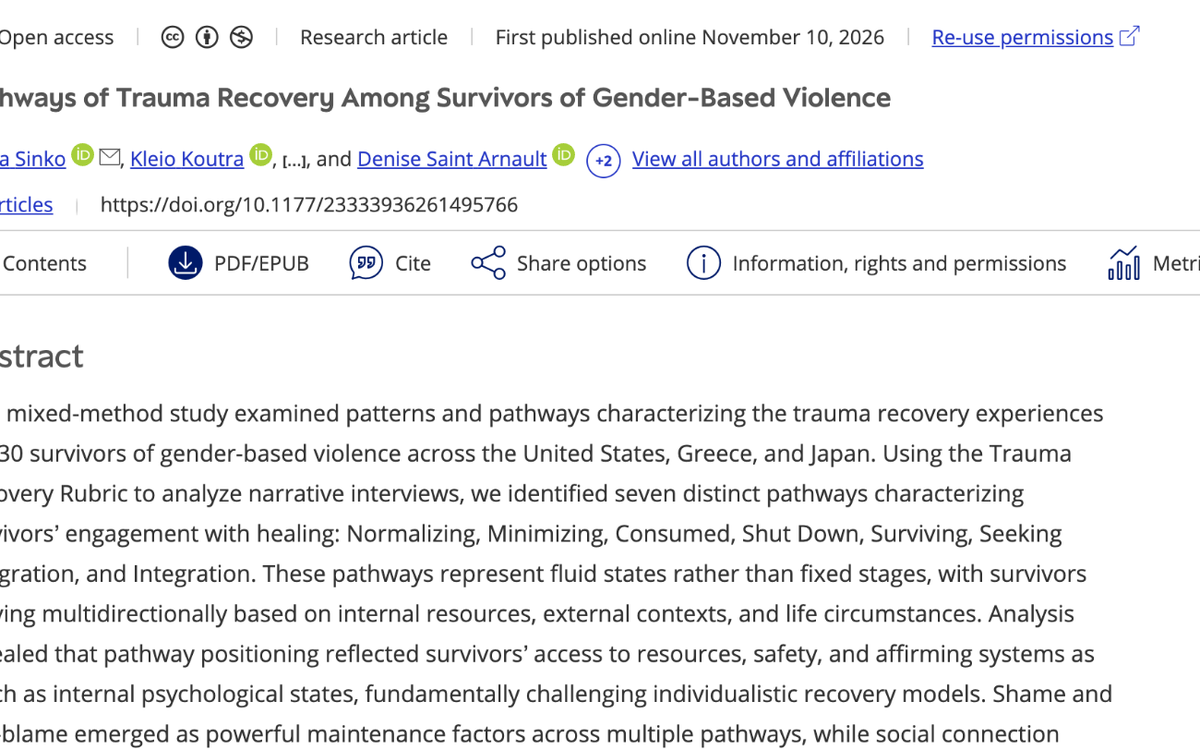
Healing after gender-based violence (GBV) rarely moves in a straight line. This mixed-method study, published in Global Qualitative Nursing Research and led by Our Wave's Dr. Laura Sinko, looked at how 130 survivors across the United States, Greece, and Japan engaged with their own recovery, and found seven distinct pathways that survivors move between.
Trauma-informed care focuses on how care is delivered: safety, trust, and avoiding retraumatization. It says much less about recovery itself. An estimated 70–90% of trauma survivors never receive trauma-specific care, even when they see healthcare providers regularly. Without a shared way to understand where a survivor is in their healing, clinicians often have little to go on beyond symptoms.
Survivors took part in the Clinical Ethnographic Narrative Interview, a 60 to 120 minute conversation that uses activities like social network maps, body maps, and lifelines to explore recovery in survivors' own words. Participants came from studies in Southeast Michigan, Philadelphia, and the Midwest, including LGBTQ+ and Muslim immigrant communities, and from Crete, Greece, and Tokyo, Japan. The team scored each interview with the Trauma Recovery Rubric, which looks at recovery across eight domains, then analyzed the interviews in depth to describe each pathway and what moves survivors between them.
Survivors' experiences formed seven pathways. These are fluid states, not stages, and survivors moved between them in both directions as their resources, safety, and circumstances changed:
Normalizing, not yet recognizing what happened as harm or trauma
Minimizing, acknowledging the harm while downplaying its impact
Consumed, overwhelmed by the trauma, with identity centered on it
Shut Down, emotionally numb, frozen, and withdrawn from others
Surviving, focused on getting through a current crisis, with healing on hold
Seeking Integration, actively working through the trauma and building support
Integration, holding the trauma as part of a coherent, balanced life story
Shame and self-blame kept survivors in place across several pathways. Social connection was the strongest force helping them move forward. Culture shaped how survivors recognized violence, expressed emotion, and understood what healing meant.
Where a survivor is on their path reflects their access to resources, safety, and supportive systems as much as anything happening inside them. That challenges recovery models that place the work on the individual alone. The pathway framework can help nurses and other clinicians tailor support to where a survivor is right now, and it shows why systemic barriers need attention alongside psychological healing.
Connection is at the heart of Our Wave, where survivors can read others' stories of healing and know they are not alone.
Sinko L, Koutra K, Zonp Z, Kita S, Saint Arnault D. Pathways of trauma recovery among survivors of gender-based violence. Global Qualitative Nursing Research. 2026;13. doi:10.1177/23333936261495766. Published open access under a CC BY-NC 4.0 license.
Our Wave depende de sus generosas contribuciones para nuestro éxito continuo. Done hoy y apóyenos en nuestra labor para apoyar a las sobrevivientes de daño sexual, violencia doméstica y abuso infantil.
Leer was Historias Dona hoy