
Research Paper: A Synthesis of Survivor-Provided Advice for Overcoming Gender-Based Violence Across Seven Countries
1月 1, 2026 • Qualitative Health Research
1月 1, 2026 • Qualitative Health Research
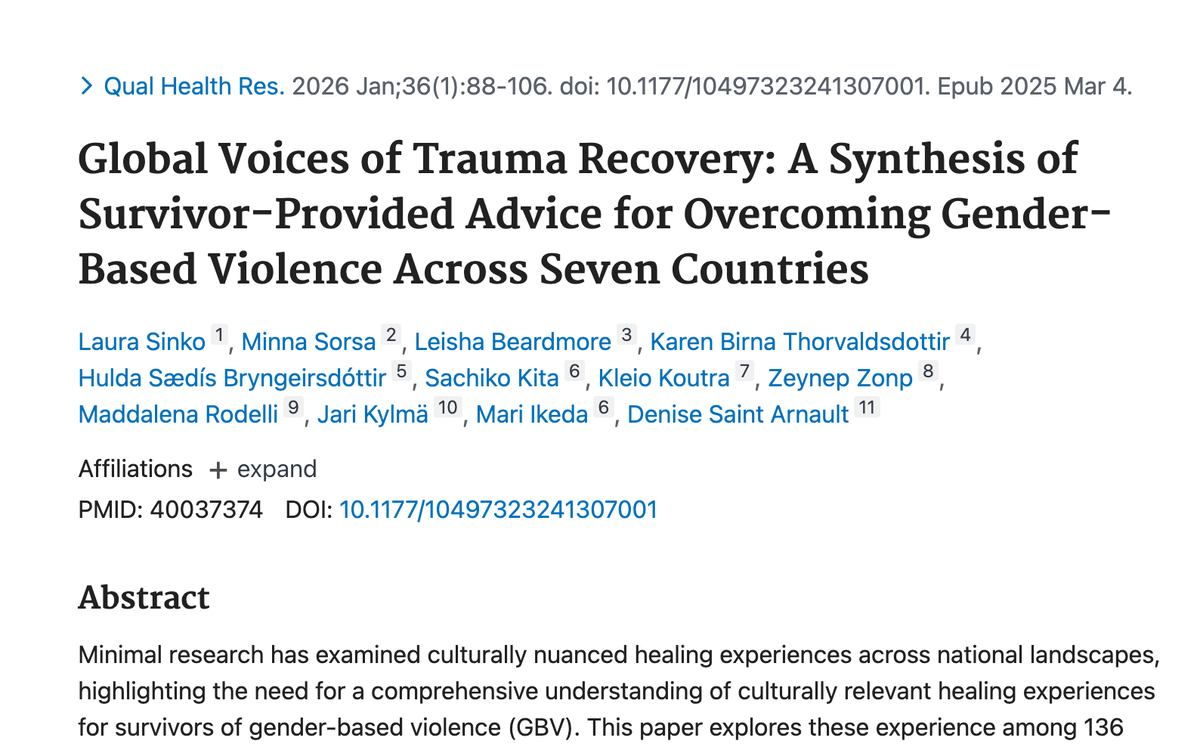
What helps survivors heal after gender-based violence (GBV), and does that advice change across cultures? This international study, published in Qualitative Health Research and led by Our Wave's Dr. Laura Sinko, asked 136 survivors in seven countries what they would tell someone else beginning their own healing journey.
Most research on healing after GBV comes from a single country or culture. Survivors heal in different contexts: different families, communities, services, and beliefs about what strength looks like. Without understanding those differences, support services risk offering one-size-fits-all care that doesn't fit the people it is meant to serve.
Researchers interviewed survivors using the Clinical Ethnographic Narrative Interview–Trauma, which invites people to reflect on their healing journey in their own words. At the end, each survivor was asked what advice they would offer others healing from GBV. The team then compared that advice across countries using the Comparative Ethnographic Narrative Analysis Method, looking for what was shared, what was distinct, and where the same idea carried a different meaning in a different culture.
Survivors' advice came together around three themes, each with culturally specific nuances:
Taking action to promote healing, through concrete steps survivors found helpful in their own recovery
Building a positive self-concept, rebuilding how survivors see and value themselves
Finding strength, and recognizing the resilience survivors carry with them
The findings call for social and health services that are contextually sensitive and shaped by survivors themselves, with healing strategies tailored to the people and places they serve. For researchers, the study shows why cultural nuance within qualitative themes deserves close attention. That attention is how survivorship care becomes more culturally relevant.
This survivor-led approach is at the heart of Our Wave, where survivors share what healing means to them in their own words.
Sinko L, Sorsa M, Beardmore L, Thorvaldsdottir KB, Bryngeirsdóttir HS, Kita S, Koutra K, Zonp Z, Rodelli M, Kylmä J, Ikeda M, Saint Arnault D. Global voices of trauma recovery: A synthesis of survivor-provided advice for overcoming gender-based violence across seven countries. Qualitative Health Research. 2026;36(1):88–106. doi:10.1177/10497323241307001