Research Paper: Our Wave, an online platform to facilitate survivor disclosure of sexual assault and trauma recovery
December 17, 2024 • Frontiers in Public Health
December 17, 2024 • Frontiers in Public Health

Director of Research and Survivor Support

Chief Technology Officer

Social Media Coordinator

Executive Director
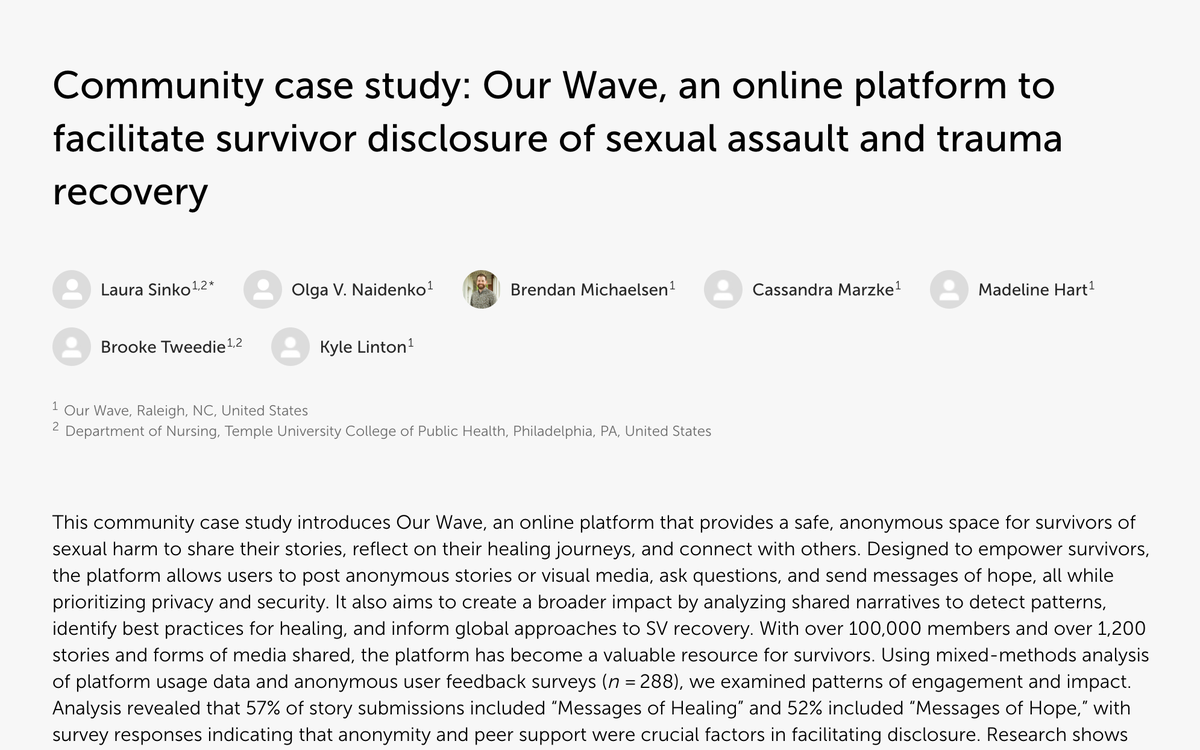
Telling someone about sexual harm is one of the hardest steps a survivor can take, and how that first disclosure is received can shape healing for years. This community case study, published in Frontiers in Public Health, describes how Our Wave was built to make that step safer. It also shares what survivors told us about using it.
Research consistently links negative reactions to disclosure with more severe post-traumatic stress disorder (PTSD) symptoms and with survivors pulling away from support. Online spaces can give survivors more control over when and how they share. But general social platforms come with real risks: hostile replies, weak privacy protections, and moderation that isn't trauma-informed. Our Wave was designed to keep the benefits of sharing online while removing those risks.
Anonymous story sharing. Survivors share in their own words or through visual media. They can add optional tags, such as identity, where the harm happened, or their relationship to the person who caused it, and choose whether their story can be used for research.
Careful review. Trained team members review every submission, remove identifying details, and add Community notes where needed.
Survivor Q&A. Survivors ask anonymous questions that mental health and trauma experts answer. An analysis of the first 100 questions found seven themes: recognizing harm, understanding trauma, navigating relationships, managing emotions and body reactions, disclosing and seeking help, embracing healing, and supporting other survivors.
Built-in safety. Grounding exercises before reading or sharing, a quick-exit button, and lists of local and national resources.
Educational exhibits. Created with artists, activists, researchers, and survivors to challenge victim-blaming and show what healing looks like.
The study combined platform usage data with 288 anonymous feedback survey responses collected between October 2020 and November 2024. As of October 2024:
Survivors had shared 1,279 stories through Our Wave and partner organizations, and 86.7% of story submissions gave consent for research use.
57.8% of stories included a Message of Healing, and 52.5% included a Message of Hope written directly to another survivor. Even while telling their own story, most survivors chose to reach out to someone else.
Engagement grew after sharing. 26.1% of story submitters read another survivor's story before sharing, and 30.6% did afterward. Visits to the resources hub doubled after sharing, from 4.8% to 10.0%.
Survey responses described the freedom of telling a story in your own words, and how reading others' stories eased isolation. As one respondent put it, "It makes me feel less alone." Survivors also asked for more ways to connect, and some wanted the option to share under their own name.
The paper outlines next steps for survivor-centered technology:
Broader accessibility, including language options and disability accommodations
Peer-support features that let survivors connect with one another
Referral pathways to professional care
Research on long-term impact and on best practices for trauma-informed moderation
Sinko L, Naidenko OV, Michaelsen B, Marzke C, Hart M, Tweedie B, Linton K. Community case study: Our Wave, an online platform to facilitate survivor disclosure of sexual assault and trauma recovery. Frontiers in Public Health. 2024;12:1458510. doi:10.3389/fpubh.2024.1458510. Published open access under a CC BY 4.0 license.
Our Wave depends on your generous contributions for our continued success. Give today and support us as we work to support survivors of sexual harm, domestic violence, and child abuse.
Read stories Give today